Join the Adventure Giveaway

Winner of the American Christian Fiction Writer's Carol Award for Dauntless!!!
Showing posts with label Perspiration. Show all posts

Monday, February 25, 2013

Edit Like a Pro!


For the last two years I’ve had the wonderful pleasure of working as an acquisitions and content editor for WhiteFire publishing. So I thought I’d pass on a little of what I’ve learned to the aspiring authors in our audience. Publishing companies take manuscripts through a series of edits in a strategic fashion from macro editing to fussing over every last comma and period. By following the roadmap that publishers use, you too can learn to edit like a pro, producing a quality manuscript while saving time and effort along the way.

I know in my case, I wrote my first novel, and then spent countless hours proofreading. Then I changed the whole book, and spent weeks line editing and proofreading again. And I followed that cycle through at least five rounds of edits. Goodness only knows how much time I wasted. Don’t make my mistake. Instead, follow this outline to edit in the proper order.

* Strategy - Purpose, Audience, Genre

At the publishing level, this first step in editing takes place even before we acquire a novel. And ideally for an author, this step should take place first as well. Of course newbie authors are still getting their feet wet. They often just follow the story or characters where they lead. Even experienced authors might do some pre-writing of this sort to get in touch with their idea. However, it is advisable to know where you’re going before you get too far into the process. You need to know why you’re writing the book, who you are writing it for, and what genre you are writing in.

These three factors will guide many important decisions along the way including things like point of view choices and length. Don’t make the newbie mistake of thinking, “This is a cross-genre book that everyone will love.” Translation: “No one in particular is going to want to read this book unless they are related to me.” Publishers need to know your purpose, audience, and genre before they even consider your book, so you should consider those factors first as well.

* Macro Editing

This level of editing can also be called content or substantive editing. Publishers generally content edit after they’ve purchased a book, but if an editor really likes an idea but sees too many problems, they might send content suggestions at this level and ask for a resubmission. Similarly, content editing by the author could take place at different points in the process—but it must take place! Some authors like to write “organically” or “by the seat of their pants” as opposed to planning and outlining in advance. That’s fine. But at some point you must go back and take control of your story.

Major content editing generally looks at issues like plot structure (proper introduction to the story, turning points, mounting tensions, climax, and resolution), characterization (consistency, goals, motives, and conflicts), proper pacing, themes, and point of view choices. All of these need to be working well before a publisher can consider your manuscript. And there’s no use fussing over scenes, paragraphs, or sentences until all of these major elements are solid and in place.

* Scene by Scene

Once a publisher has acquired a book and made certain the big elements are all in order, they move to editing on a scene by scene basis. This could also be considered part of the content editing, but for the writer, this level needs to be addressed separately.

After those big elements are in order, each scene should be carefully examined. First, decide if the scene even earns a right to be in the book. Something significant should happen in every scene that drives the story forward or adds to character development, preferably both.

When you’ve decided that the scene stays, make sure that it’s strong and active. Check if you have entered the scene properly. To enter a scene you should quickly establish the time, place, and point of view character. These elements are necessary to pull your reader into the fictional world. This can be best done with some sensory details about the setting from the point of view character’s perspective. While you might choose to start with a few lines of dialogue, within the first few paragraphs, you need give us this information. 

Once the scene is going, make sure that there is conflict (or tension) in the scene and something happens that shifts the dynamic in the scene. You don’t want a static scene. Examine the scene to make sure that there is a nice mixture of dialogue, action, description, and internal monologue from your point of view character. The best scenes weave these all together. Also check that the five senses and adequate emotion are used throughout. Finally, exit the scene with a strong closing hook that will drive the reader to keep going into the next scene.
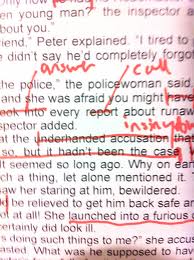
 *Line Editing, Copy Editing, and Proofreading

After the content of a book is all finalized, the next level of editing is line editing. At this level the editor examines sentences and paragraphs to make sure the writing is effective, tight, and properly communicates the author’s intent. Often sentences can be combined or restructured to better express the meaning. Sometimes connectors or further description are required. Sometimes redundant words or lines are cut. Another main goal of the line editor is to make certain that the prose is fluid and pleasurable for the reader. When line editing your own work, it is very helpful to read the text out loud to yourself. Your ears will catch many problems that your eyes are not likely to see.

Next comes copy editing. Copy editors study all the words, looking primarily at grammar and punctuation. They know the publishers style guidelines and apply then to the manuscript.

Finally, the publisher will take the manuscript through the proofreading stage, in other words, looking at every single letter and punctuation mark for typos. Often this is done by a number of people after the book is available in the “Advanced Reader” format. You might want to ask friends, family, or your beta readers to help you with this stage. When looking for last minute errors, it is helpful to read the manuscript on a printed page, read out loud, and if possible, have a text to speech program read it to you. These last three stages are sometimes compressed into only one or two stages by publishing companies, but be sure that you treat each one separately.

So that’s the road map. Notice how it starts big and works it’s way in. Remember, by using these techniques in proper order, you too can learn to edit like a pro.

Writers, what are some of your editing secrets? Readers, what are you pet peeve problems that you find in books and wish authors would do a better job at editing out? 


Monday, June 25, 2012

To Be or Not To Be - A Ridiculous Lesson in Self-Editing

Shakespeare posed his prolific question centuries ago, but perhaps he would have never guessed what it might mean to writers today. Yes, I’m referring to the dreaded “to be” verbs. Now if you’re a reader and not a writer, we’re about to tread into some terribly deep writing waters, but you might still enjoy this look into the twisted world in which your author friends attempt to live and work.

I’ve talked before about “the rules” of fiction writing. Often we hear a basic rule, but don’t understand the finer points. Don’t understand how to harness it and put it to practical work in our writing. One of those rules, discussed last week both on the American Christian Fiction Writers, is the one that says “avoid to be verbs.”

Now you might say, that’s just silly. I might say so too. But it’s not so silly once you understand the how’s, why’s, when to’s, and when not to’s of this rule. In fact, I’m working on my first big editing project for WhiteFire, and guess what one of my main issues with the book was? Exactly. Too many to be verbs.

Obviously there are time we need to be verbs (is, are, was, were, be, being, been) as well as other linking verbs. But in general the goal is to keep our verbs as active, specific, and powerful as possible. Let’s look at some problems to be verbs can create.

1)      Repetitive: Probably my main issue with to be verbs is that they quickly become repetitive. In writing we want to stay as varied as we can. We don’t want: The house was small. It was dingy. The door was covered with chipped paint. We want: The small, dingy house cowered against the horizon. Paint chipped from the door, as if it could not escape quickly enough. Be creative. Be original. It’s our job.

2)      Passive: The next problem that often occurs with to be verbs is that we use them in place of stronger, more active verbs. Example: I was hungry and tired. There’s no action. Instead try: Hunger grumbled in my belly and fatigue weighed heavy on my limbs. Not only are these more interesting and active verbs, they have more sensory impact. Perhaps the most passive of all is the “It was” or “It is” construction in which the “It” does not represent any actual noun. Example, “It was Sunday morning.” How about, “Sunday morning dawned bright and clear.”

3)      Telling: Another name for this sort of passive structure would be the dreaded “telling” that writers are warned away from.  In the first version above the reader is being told hungry and tired. In the second, they really begin to see and even feel the hunger and fatigue. When you notice whole passages are filled with to be verbs, chances are you’re using narrative summary. While this sometimes can be the most effective tool to quickly let us know something that happened, it packs no emotional punch, so use it sparingly.

4)      Distant: Related to the whole passive and telling issues, to be verbs can also create distance between the reader and the scene. You want your reader to feel drawn into the moment. Even into the body of your point of view character, as if they’re living out a fictional dream. To be verbs as well as unneeded helping verbs can destroy this illusion. Here’s an example with was as a helping verb. "She was walking to the door. She was pushing open the door, and then she was pulling out a cart." Perhaps this would work for some sort of out of body experience or for an observation of someone else, but otherwise, bring us right in close. "She strode with purpose toward the store, pushed open the door, and yanked out a cart."

5)      Boring: To be basically means equals. From the example above I = hungry and tired. Other linking verbs do this as well. And none is used more often than felt. I felt hungry and tired means the same as I was hungry and tired, which  means the same as I = hungry and tired. And they’re all BORING! There is a proper use for words like felt. For example, “I felt like I was about to die” actually means something completely different than “I was about to die.” Sometimes we need these verbs, but don’t be lazy with them.

You may have noticed that I also used was in my good example in the previous paragraph. That’s because often we need to. Now let’s look at some proper uses of to be verbs.

1)      Dialogue: In dialogue people should talk like people, and should speak in a way consistent with their character. Most people would never say, “I am weighed down with fatigue.” Unless maybe they’re an over zealous author or live in 1780. In dialogue most people would just say. “I’m tired.”

2)      Internal monologue: Sometimes an author gets so deep into the head of their point of view character that it basically is like dialogue. It’s the characters voice, not the authors. During these moments, use the words your character would use. “She couldn’t believe it. It was wrong. Just wrong. No! It was beyond wrong. It was unbelievably, shockingly, and unforgivably wrong!” As you can see, I especially like to be verbs in tirades.

3)      Simplest tool: And here we get to the heart of thinking like a seasoned, professional writer. Sometimes it’s just simpler and more to the point to use a to be verb. I learned from Angela Hunt that we have many tools in our writing tool boxes, and we shouldn’t use a sledge hammer when all we need is a little tap. Sometimes in order to avoid to be verbs we use sledge hammers. That’s not good. For example, it might take a paragraph to use active verbs and show, “He was wrong.” And maybe in that moment you just need to say it and move on.

So those are some of my thoughts on “to be” verbs. What are yours? Did you know about this rule? Have you ever been annoyed by it?


Sunday, May 13, 2012

Entre-author

The new hot thing this year seems to be coming up with one word to encapsulate your goals. Even before I noticed this trend, I had spotted my word for 2012 in a quote from Mary DeMuth on Author Media. Are you ready for it…Entre-author. A friend asked if this had something to do with an author entering, like the French entre vous. Actually, I think it does. To my understanding it is a mix of entrepreneur and author. Therefore, I suppose it is a writer ready to enter the big leagues.

This word captured what God had been laying on my heart for the last half a year . You see, I started my novel writing journey as an art and a ministry. At some point I realized in order to succeed, I would have to understand writing as a craft and a business as well. But just late last year, it hit me that I had two teenagers headed for college and needed to start making a serious income from my writing. As my debut, small-press, medieval novel struggled for sales, I watched my crit partner’s first “marketable” novel thriving. My desires began to undergo a change. While I still wished to touch lives, I now wanted to provide for my family through my writing as well.

Of course the question that remained was whether or not I could write to market while achieving my artistic and ministry goals, but I determined to try. At my agent’s urging, I prayed for several weeks for a marketable idea. Finally, a title dropped into my head, and a story began to unfold in my mind.

As I sat down during NaNoWriMo to pen my first “market-driven” novel, an amazing thing happened. I chose my hot genre, my popular setting, and even focused on plot for once in my life. Each time I had a decision to make, I asked myself what would be more entertaining. But as I did so, my voice and themes still found their way into the novel with little effort. The book still fit my “Dina Sleiman ~ Dance with Passion” tagline. It still depicted intimacy with Christ. And as I sat in church the first Sunday morning after I started it, God even gave me a vision for a worship dance scene that I could weave organically into the plot and setting. Something I hadn’t dreamed of for my Scarlett O’Hara meets Jane Austen novel.

Last week my agent sent this Virginia set historical romance off to a bunch of publishers, and truly, I couldn’t be happier with it. Who would have guessed? I can write a novel to market and still love it myself. I learned something important through this experiment. The outer trappings of the novel are not what matters. If God is in the mix, His purposes will be accomplished. The heart of the novel is what counts.

Saturday, September 4, 2010

Personality Types - Writing Class Series Bonus Lesson

I’ve enjoyed this writing class series so much, that I think I’ll do a few bonus lessons based on extra discussions we had during the live class.

One of my favorite things we ended up talking about in detail was a personality indicator used by psychologists called the Meyers Briggs assessment. I love this test for a number of reasons. In general, personality tests help us better understand ourselves and our unusual little quirks. They also help us to understand that each of our brains are wired in an individual way through genetics and upbringing. They assist us in understanding others who have vastly different personalities than our own. As writers, these tests help us to write consistent characters with distinct personalities and clear motivations.

I prefer the Myers Briggs test because it breaks down to sixteen different personality types and is more targeted and specific than any other test I have found. Another reason I prefer it, is because it is well known and you can find a number of excellent websites and books that talk in detail about these personality types. You can easily look up what a person with an ENTJ personality would choose as a job, or how they deal with relationships. This is particularly helpful to writers creating characters.

My new contemporary novel is a sisterhood type of book with three main female characters. These three women needed to have enough in common to be drawn to one another, yet still have distinct personalities. So I chose a Myers Briggs type for each of them and used that to help with their characterizations.When I wanted to know what would be a good career for one of my girls, I could easily look it up online. When I wanted to know what type of man would be a good match for them or how they would respond to stress, I could look it up. Pretty cool, huh.

The Myers Briggs assesses four aspects of human characteristics. Keep in mind that everyone has all of these traits, and it's good to be balanced, but that we all lean more heavily towards one or the other.

Introvert vs. Extrovert – This has to do with how you are energized. It is not about how shy or social you are. An extrovert is energized by the outward world of people and things. An introvert is energized by their inner world. An extrovert is always up for a party and comes home excited and full of energy. An introvert may enjoy the party, may even be the life of the party while there, but will be exhausted by the end and need to go home and regroup. Extroverts need to process things with others. Introverts need to process things alone. Extroverts quickly grow lonely and have a stronger need for others. Introverts are content with their own company.

Sensory vs. INtuitive – This has to do with what you pay attention to. Sensors focus on the five senses and on facts. Intuits focus on what might be called a sixth sense. Sensors are very aware of their surroundings whereas intuits might drift off into their own head. Sensors tend to seem more grounded in realism than intuits. Sensors deal with basic information and intuits tend to take in information, but interpret and add their own meaning to it.

Thinkers vs. Feelers – This has to do with how you make decisions. A thinker takes into consideration logic and reason only. A feeler takes into consideration people and their emotions. Feelers incorporate values and subjective judgments into their decisions. If you change how a thinker thinks about a subject, their feelings will naturally follow. If you change how a feeler feels about a subject, their thoughts will naturally follow. I have found you can best tell your preference in this category by asking yourself, “If logic and feeling are in opposition to each other, which would I regret not following?”

Judgmental vs. Perceptual – This has to do with how you live and work. A judger prefers to be planned and organized. A perceiver prefers to be spontaneous and flexible. Judges are strict on themselves about keeping commitments and following rules. Perceivers view commitments as something they will probably do and view rules as suggested guidelines. Judgers tend to be on time and be early for deadlines. Perceivers tend to be late and procrastinate. Judgers like to know where they are going and how to get there. Perceivers like to go with the flow and respond to where life might take them.

By choosing the four letters, you find the personality of your character. For example, I am an INFJ (which is both the rarest personality type in normal people and the most common personality type in novelists by the way). You can go online and find career advice, relationship advice, strengths and weaknesses, etc…for this personality type by looking up these four letters. Different books and websites have varying views, so I recommend you look at several. This website as a good place to start. It is full of exhaustive information. Be sure to scroll over the little icons for the links and also to look at the bottom of each page for sublinks. http://www.personalitypage.com/html/info.html

If you would like to take the Myers Briggs test for free, here is a good version http://www.humanmetrics.com/cgi-win/JTypes2.asp

We also discussed how these personality types affect you as a writer. Let's start with a very natural writer type, mine, the INFJ.

If you are an "E" for extrovert rather than an "I" for introvert, you may find that you write better as part of a team. You may need to go somewhere around people like a cafe or bookstore in order to write. And you will certainly need to join writers groups and be a part of a community. You would probably enjoy writing that involves meeting and interviewing people. Most writers are introverts, since it is primarily a solitarty activity. But introverts, be careful not to become a recluse. Writers need the emotional support of other writers.

If you are an "S" for sensor rather than an "N" for intuit and you want to be a writer then I'm not sure what to tell you. It's not that an "S" can't write, it's just that they usually don't view writing as a practical enough pursuit. If you desire to write, then you must be fairly balanced between the "S" and the "N." I would also guess that you are an introvert, because something must be drawing you to the inner world of writing. You will probably view writing as a craft. I'm guessing that reporting or fictional mysteries would appeal to you because of the sensory aspects. You may find that you enjoy writing teaching manuals or how-to type material because of its practical application. And you might make an excellent editor because of your attention to detail. Intuits will likely have good instincts for writing and also good instincts. They will enjoy the imaginary aspect of writing.

The "T" for thinker can also be a good writer, but they will probably focus more on facts and research than the "F" who might like to be more creative. The "T" might enjoy writing nonfiction or fiction that requires extensive research, and they will probably rely more heavily on formulas and structure in their writing because those aspects focus more on logic. If you are a feeler, don't get so creative that you forget to keep your facts straight.

Finally, if you are a "P" for pereciver rather than a "J" for judger, then you can still be an excellent writer, you just might not ever finish a book. If you do, you will need a publisher who is lenient on deadlines. You will probably be a "seat of the pants" writer, rather than a plotter. But, remember that it's important to examine your "organic" plot structure and make sure it's strong after you've finished your book. By the way, if you are a judger, be careful not to become too focused on the rules or too locked into your plot. This is probably an area that the judgers can learn a lesson from the perceivers. Just don't slack off on meeting those deadlines :)

Wednesday, August 25, 2010

Getting It Out Into the World - Writing Class Series Week 8

During week 1 of “The Inspiration and the Perspiration,” we attempted to define Christian writing. Here’s what we came up with:

Christian writing is any writing inspired by the Holy Spirit with the goal of advancing God's kingdom on earth.

This definition implies that ultimately, we want our writing to find an audience so that it can touch lives and change people, at least in some small way. That means, for our writing to achieve its purpose, we have to get it out into the world. We don’t want to hide our light under a bushel. We don’t want our writing to sit in a drawer or computer file where no one can read it. There can be a therapeutic type of personal writing, however, if you’ve invested the sort of time I've suggested in this series, that is probably not your goal.

For smaller pieces like short stories, articles, devotionals, and poems, blogging can be a fun and easy way to find an audience. You can also begin to look for magazines and journals. The Writer's Market, available at bookstores, libraries, and amazon, is the best resource for finding places to submit your writing. They have new versions each year and multiple editions specializing in various genres. There is also The Christian Writers' Market Guide. If you regularly follow a certain periodical, consider writing something specifically to fit their needs.

Now on to full books. Here’s the bad news, on a very practical, business type level, in order for your book to sell well, you will need to begin to view your precious baby--the result of years of blood, sweat, and tears--as a product. Yes, you heard me, a product not at all unlike a Big Mac. It will need to be packaged, distributed, and marketed. What we have previously called your “audience” will now become your “target market.” While on some levels marvelous writing speaks for itself, there is a business side of writing as well. You need to get at least some people reading your book and spreading the word if you want it to reach farther than friends and family members.

On the other hand, be realistic and understand that only a handful of Christian writers actually make a living at writing. Writing can be a profession, but at least in the beginning, it will probably need to be more of a hobby or a ministry. Still, we want to reach the largest audience possible. There are three main routes you can take for getting your book out into the world. So let’s discuss the pros and cons of each.

The traditional route, which is preferred by most authors, is to find a major publishing house to contract your book. If you can find a major publisher, they will do an excellent job editing your novel and making it the best it can be. The con is that you lose some control over the content of the book. They will provide a professional cover design. However, you will have little or no say concerning the cover. Your book will be distributed in bookstores, on Amazon, possibly even retail stores like Wal-Mart, so they will reach a large potential audience. On the other hand, a good run for a Christian novel is about 10,000 books, and you will receive only 5-10% of the profits. Probably less than a dollar per book. Another pro for traditional publishers is that you will receive a lump advance. In other words, you might make $5,000, even up to hundreds of thousands for secular best-selling authors, in advance. The down side of the advance is that if the publisher does not make their money back, you might have a hard time contracting another book--with anyone.

Traditional publishing is still the preferred route, because it provides a large potential audience. It also provides marketing and promotion. However, the traditional publishers have less influence in this area than they used to because their primary sales are switching from small booksellers to mega bookstores and online booksellers. These days, royalties are smaller than ever, and at the same time, authors are expected to do more and more of their own marketing and promotion. Not a great deal. At the end of the day, I think most authors still dream of the big publishing houses because they offer instant validation and respectability. If you’ve been published by one of the big Christian companies: Baker, Zondervan, Thomas Nelson, Multnomah, etc… people know that you have made it, and you are now a “real” author.

Now for more bad news. If you decide to go the traditional publishing route, you will not be able to send your manuscript to any major publishers. You will need to first find an agent. In order to find an agent, you will need to prepare query letters, book proposals, and sample chapters. (You will also need this if you decide to go the small press route.) Go online and begin researching agents who represent your genre and how to write these all important marketing tools. You may want to consider hiring someone to help you write your first proposal. I did, and I had many requests for full manuscripts from agents. Agents generally charge about 15% of what they help you earn. In addition to being your gateway to the publishing world, they also provide legal advice, handle contract negotiations, and in many cases, even help you improve your writing. If you want to go the traditional publishing route, finding an agent is well worth the effort.

If you truly want to forego the agent, you have only a few options left for pursuing a major publisher. You can try to meet acquisition editors at writer’s conferences and pitch your book to them in person. Make sure you do your research and learn which editors will be there ahead of time. There are also a number of writing contests that send the winning entry to an acquisitions editor. Again, do your research. Finally, there are online services that will advertise your manuscript to editors for a fee. I personally don’t know anyone who has gotten a contract through this route.

The next way to get your writing out into the world would be to look for a small publisher, or “small press” as they are often called. These publishers do not pay large advances, and they generally do not sell as many books. On they other hand, they are more accessible, more personal, and willing to take more risks. These publishers are more likely to contract a book with a smaller market such as literary writing or an obscure genre. They are still respectable, and while they may not have the name recognition of the big companies, an author can still feel that their work has been validated and someone is willing to invest in publishing their book. Books published by small presses are eligible for all the same awards and accolades as books published by large publishers. In addition, the author tends to have more input, and in many cases, earns higher royalties. While an agent can still be helpful, many small presses will accept queries and proposals directly from authors. You can find lists of small presses in The Writer's Market and The Christian Writers' Market Guide. Be careful to follow their submission guidelines to the letter. Same is true when submitting to agents. Please remember that a reputable small press will not charge you a penny to publish your book.

The final way to publish a book is “self-publishing” or “vanity publishing.” This should not be a first choice, because in addition to the cost, it is not as respectable and could actually hurt the author’s reputation. However, there are instances in which self-publishing can be a good idea. If you are a pastor, public speaker, or well-known in your field and write a nonfiction book in your area of expertise, self-publishing can be a good option because you already have an audience and the name recognition to sell books on your own. You keep a much higher percentage of the profit when you publish your own book, so if you already have access to an audience, this can be a wise business decision. Self-publishing is a great idea if you primarily wish to distribute your book among family and friends. Finally, in rare instance where a book has no clear genre or an unpopular genre, self-publishing might be the only way to get it off the ground. I can only think of one example, but it’s a doozy. The Shack is a bizarre Christian allegorical novel that started as a self-published book and went on to make the New York Times best-seller list and millions of dollars.

If you decide to self-publish, again, do your research and make sure you are getting a good deal. WinePress and Westbow are two Christian companies reported to have good reputations. You can also do small print on demand runs or even offer your manuscript as an ebook and keep the cost low in that manner.

So, as I’m sure you can see, no matter which route you go, you will need to learn the business side of being an author. Writer’s networks and conferences are great places to learn the tricks of the trade. Christian conferences and loops will provide information specific to Christian publishing.

And, as I’ve mentioned, even once you have the illusive contract in hand, most publishers will still ask that you be active in marketing and promoting yourself. This is something you can actually begin now through methods like a website, blogging, and being active on social networks such as Facebook. Once your book is published, you can also consider methods like book launch parties, book signings, interviews, and speaking engagements.

As always, what I’ve shared here is just the tip of the iceberg for getting your writing out into the world. You can see it’s a lot of hard work, but if God has truly laid this message on your heart, then it will be well worth the endeavor. Writers go through the pain of writing and editing because they need to write. They go through the pain of publishing because they need someone to read what they have written.

So, I hope that in these eight weeks I have given you a picture of how a book is brought into being--from the idea stage, through all the hard work of writing and editing, and now out into the world. For many of you, this has probably been a reality check on how hard writing actually is. For some, it has provided a much needed roadmap for a journey you long to take. For yet others, it has helped you to spot areas in your writing process that can be honed and strengthened in order to take you to that next step. I hope everyone had as much fun as I did learning about “The Inspiration and the Perspiration.”

Homework: Finish that book and get it out into the world!

Thursday, August 19, 2010

Editing Line by Line and Word by Word - Writing Series Week 7

Before we move into today’s subject let’s take a minute to review the full process of inspiration and perspiration. First, we must have a good handle on what Christian writing is and our purpose for undertaking this task. Next, we purposely posture ourselves to receive inspiration from the Holy Spirit in the shape of our “lump of clay” writing. If we already have an idea, we search for input from the Holy Spirit  as to what we should do with the idea. We must realize that inspiration is not enough and be willing to do the hard work, or the perspiration, of the writing process. Once we have gotten our initial ideas down on paper, we should take time to structure the ideas through an outline or a plot summary. We write the book, using fictional and artistic elements to strengthen the basic story or premise. We edit chapter by chapter and scene by scene to make sure we have utilized these elements to their full potential and balanced them well.


Which brings us to today. Just as we went through each scene to make sure it pulled its weight and lived up to its full potential, we must also search our manuscripts paragraph by paragraph, sentence by sentence, and word by word. This is the sort of in depth crafting that is the mark of a true artist.
Here are some of the things you can look for concerning paragraphs. Are paragraphs divided properly to keep the story flowing effectively? Could long paragraphs be divided? Could sentences within paragraphs be combined for greater efficiency of language? Could powerful sentences be set apart in their own short paragraph for greater impact? In dialogue, does each paragraph represent a single speaker’s words, thoughts, and actions?

On a sentence by sentence basis ask yourself if every sentence is necessary. Could redundant sentences be removed? Is punctuation working in an effective manner? Could complex sentences be changed for stronger parallelism? Should long sentences be broken into two? Try not to use words more than once in close proximity unless you are intentionally creating a sense of refrain.

Now we get to the true nitty gritty. Word by word editing. First realize that just like in a poem, we want to use each word to its maximum benefit. I mentioned in my “Top Twenty Things I Wish I Knew Before Writing My First Novel” that you should pay yourself $.25 for every word you can remove. Economy of language is a clear sign of an experienced writer. A possible exception is in dialogue, but remember that fictional dialogue is representative speech, not actual speech. Readers will not put up with rambling ineffectual dialogue.

Here are the types of words you can look to remove. Begin with excess adverbs and adjectives. Adjectives are good when used selectively, however, don’t string together lists of adjectives with similar meanings. Chose the best one and delete the rest. Adverbs are almost a bad word in fiction, but sometimes they can be effective. Begin by removing words like "very" and "really" that don’t “really” add anything to the sentence. (I told my husband recently that maybe if he said "very" three or four times in a sentence he would convince me it was important. Note the sarcasm.)  Do a find search for “ ly” and remove any adverbs that aren’t strengthening the meaning of the sentence. Try to replace an adverb/verb combo with a stronger verb if possible. When do you keep an adverb? Only when it changes the meaning of the verb and there is no verb to take its place.

Remove statements of the obvious like “stood to her feet.” Remove or replace any words you tend to overuse, or so called “weasel words.” Examples would be: just, well, still, oh, that, had. I’m sure you’ll figure out your own list before long. Remove helping verbs and linking verbs as much as possible. Of course they are sometimes needed. “Had” is needed to enter and exit that past perfect tense. If you have long segments full of helping verbs, see if you can move the segment to a more active moment. Strong action verbs that really “show” something happening are always the best choice.

And speaking of verbs, be sure to keep your book in a consistent verb tense. Most novels are written in past tense. A few are written in present tense. This is a new trend, but hard to execute. Others are written in the present tense with long sections of flashback in past tense. This can work well. When you find yourself in the past perfect (had run, had gone, etc…) tense, this is probably a recollection. If the segment is long, consider changing it to its own flashback scene. One of the clearest signs of an amateur writer is lack of control over the verb tense. So whatever you choose, make sure you do it well and consistently.

Another area to check into on a word by word basis is the accuracy of your word choice, especially in historical, legal, and scientific stories. Most writers of American and English historicals check to make sure that each word they choose existed and was used in that sense at the time they are writing. That’s a lot of work. Trust me, I know. While I couldn’t limit myself to words available in the 1300s for my medieval novel because the English language was still evolving and unrecognizable to most contemporary readers, I did make every effort to choose words available by the time of Shakespeare and King James when the language stabilized into Modern English. Even if you get the words right, watch out for longer sayings, expressions, and figures of speech. For example, I discovered the word “tackle” only applied to fishing supplies until the invention of American football in the 1800’s. And the word “teenager” is actually a modern invention as well, since people took on adult responsibilities at a much younger age throughout history.

That brings me to what most people think about in reference to editing: those hundreds of spelling, grammar, and punctuation rules. I will tell you what I tell my college students. “If you haven’t learned them by now, I’m not going to try to teach them to you.” Here’s what you need to know. If you aren’t good at English, get help. I usually ask at least five well educated friends to read my manuscripts and look for errors, and I’m an English teacher! It’s just too easy to overlook your own mistakes. If you expect that you will have extensive errors, then consider paying a copy editor. It’s not cheating to get help. You’ve written an entire book for crying out loud.

Give yourself and your manuscript the respect that you deserve by making sure it is edited well before sending it to agents or publishers. The days of publishers being willing to overlook mediocre grammar in otherwise great writing are long gone with the manual typewriter. We now have computers, spell check, online grammar resources, countless editorial services. Messy manuscripts are considered lazy manuscripts. Agents and publishers will not put up with them. There are thousands of well-written, properly edited manuscripts waiting in a pile to take their place.

Of course, after all that hard work, you will still have basic typing errors. Even most published manuscripts have a few. But try to get rid of as many as possible. The cleaner your manuscript, the happier your potential agents and publishers will be. Here are some of the steps I personally take my manuscripts through to ensure that every word is perfect.

1. Read on paper
2. Read out loud
3. Have a voice to speech program read it to me
4. Ask friends and family members to read it

And after all of that, you should finally have a strong manuscript. Then you begin part two of your very long and tedious journey. Finding a way to get that book out into the world. Come back next week as we will wrap up the series by discussing how to see your book through to publication.

Homework – take one to three pages of your lump of clay writing, and turn it into a finished product.

Thursday, August 12, 2010

Resources for Writing/Editing - Writing Class Series Week 6

I am actually vacationing in Florida with my family today. The live class at Acts 2 Church will be having a critique session. Your assignment is to share some of your writing with a supportive person or two, and ask them to evaluate it by this critique list. You could also post something you’ve written in the comment section, or email up to three pages to me at dinasleiman at gmail dot com. Type it out the normal way.

This is probably a good time to mention the importance of critique groups or critique partners. It is very helpful to find a few writers of similar expertise in similar genres to trade manuscripts with. They can help you isolate problems in your writing. They can also provide much needed encouragement. However, the wrong sort of critiquers can be discouraging, even harmful. So take time to look into your options and check out possible critiquers before jumping into anything. I wrote my first novel without critique partners. But, I paid a writing coach to critique the manuscript, which served the same purpose. Last year when I realized I needed critique partners for my new projects, I slowly courted a few women in my writer's groups until I found the right ones. I'm thrilled with my critique partners, and I've learned and grown so much through both their comments and suggestions, and through critiquing their writing. It's certainly something to look into.

Critique groups can be local or online. I like my online critiquers because they share my love for Christ, history, romance, and literature. That would be hard to find on a local basis. Also, critiques can vary from general comments and encouragement to detailed line editing, so be sure to communicate your needs and desires as well as where you are in the writing process with your critiquers. There's no point in them wasting time fixing grammar on a first draft. Finally, critiques are usually traded for critiques of similar length and scope. However, if you find the right people, you will probably become flexible on this issue.

Here's the critique checklist for this week's assignment. Since the lesson is short, I will also use it to give you my list of 20 things I wish I knew before writing my first novel, some self-editing tips, and some poetry exercises.

Critique Checklist 
Please be honest, but offer positive critique to balance negative. These are only suggested questions. Use them as a springboard for your discussion.

Ideas:
Is there a clear purpose?
Is there a specific audience?
Has a specific genre been chosen?
If the author offered a plot or outline, is it effective?
Where can the plot or outline be strengthened?
What do you like/dislike about the idea?
What changes would you suggest?
What step should the author take next?

Nonfiction:
Is the thesis or premise clear?
Do they introduce the idea?
Does the body follow a clear linear or weaving progression?
Could the organization be improved?
Did the author make his/her point?
How could their support or examples be improved?
Do they have a strong conclusion?
What did you like/dislike about the piece?
Did the concept interest, inform, or persuade you?
What changes would you suggest?

Fiction Scene:
Did the author pull you into a fictional world?
What genre was it?
Did the story have character in conflict?
Was there a clear point of view?
Was the scene effective?
Which fictional elements did they use?
Which fictional elements could be added?
What did you like/dislike about the piece?
What suggestions would you make?
Did the piece hold your interest?
What is the author’s plan for the plot of the entire story?
Will this scene advance the plot?

Poetry:
Does the poem have an appealing look on the page that fits its purpose?
How does the author use sound elements in this poem?
How does the author use imagery?
Did they engage the five senses?
Is there any symbolic meaning in the images?
Do sound, image, line breaks, and look on the page work together to form a meaning?
What meaning do you take from the poem?
What did you like/dislike about the poem?
What changes would you suggest?


Top 20 Things I Wish I Knew Before Writing a Novel

1. The 15th Chicago Manual of Style is standard for fiction.
2. Industry standards have changed. You can’t write like authors from 20 years ago.
3. Write to an attention deficit society that grew up on TV and videos.
4. Think of your novel in terms of scenes. Scenes occur in a clear time and place.
5. Scenes move the plot forward and contain visual action in a present moment.
6. Plan plot beforehand by the plot skeleton or similar model, even if it will change.
7. Every line should either move the plot forward or deepen character development.
8. Cut lines and scenes that don’t do their job.
9. The ending of each scene should thrust the reader into the next.
10. Short narrative summaries are permissible if framed within a scene.
11. Description should be shown in conjunction with action.
12. Show someone moving through a scene and describe the scene that way.
13. Show someone doing an action and describe them in the process.
14. Write your sensory details into the action.
15. Your words should pull double duty as much as possible.
16. Pay yourself $.25 for every word you can remove
17. Keep dialogue segments visual as well.
18. Use action beats in place of dialogue tags.
19. Write in a distinct genre
20. Know the standards, conventions and lengths for your genre.


For the following helpful self-editing rules apply the 9 out of 10 times caveat and remember that these rules are more flexible in dialogue.

1. Do a “Find” command for problematic words.
2. Remove as many “weasel” words as possible: just, very, rather, began to, started to, that, there was, suddenly, quickly. Sentences read better without them. Also figure out and remove any words you tend to overuse.
3. Remove all adverbs from speech tags. Make dialogue or action beats do the work.
4. Remove as many adverbs as possible without changing meaning
5. When you can’t remove an adverb, check if a stronger verb would solve the problem
6. Replace passive verbs with active ones as often as possible: was, were, is, are
7. Remove helping verbs as much as possible. Try restructuring sentence.
8. For passages full of helping verbs, consider moving to a present moment
9. Remove most hads. Only use one to enter past perfect and one to exit. Had is unnecessary if passage of time indicated.
10. Remove statements of the obvious. Ex. – stood from his chair, scratched with her hand
11. Don’t use a series of adjectives that mean the same thing. Choose the strongest.
12. Remove exclamation points. The words should do the work
13. Remove as much italics as possible, all would be great.

Poetry Exercises

1. Take a picture from a magazine and write a descriptive passage focusing on creating the emotion in the picture through tone and sound

2. Choose an interesting object and describe it using all five senses, use the details to make it a symbol for something bigger in life

3. Try writing to different styles of music, write what you’re picturing in your mind, let the music influence the rhythm and emotion

4. Have one person write the first line of a poem and pass it around the room each adding a line as you go along

5. Take a descriptive passage and rewrite it in iambic pentameter. Now try again with a different sort of rhythm

Thursday, August 5, 2010

Crafting Chapters and Scenes - Writing Series Week 5

Last week we discussed the overall plot or structure of a book. As you begin editing your initial lump of clay writing (or as I like to think of it—word vomit), structure should be your first consideration because it affects the book as a whole and can sometimes require huge changes, or macro-editing. Next begin to look at your book on a chapter by chapter and scene by scene level to see how all the various elements are working together.

In a nonfiction book, examine each of your chapters to see if they are working as strong individual essays that prove your point. Examine your details that you use to support the point in each chapter. Could you dig deeper? Could you choose stronger examples? Could you add more story elements to bring your examples to life? Does the chapter either 1) follow a strong logical progression ending with a conclusion, or 2) follow a woven pattern ending with a strong wrap-up. Also, does this chapter tie in well to the chapters surrounding it?

For novels, scripts, biographies, and examples within nonfiction books, let’s move on to how to use artistic and fictional elements to their full potential in your writing. If you’ve never taken a creative writing course, you may have some catching up to do. Go to websites like http://www.la.unm.edu/~katem/E102fa03/fiction_terms.htm   and http://www.poetryresourcepage.com/teach/fgloss.html  to brush up on some basic fiction terms before moving on with this lesson. If you aren’t familiar with them—get familiar with them quick. And before you start weaving these elements into scenes, practice writing smaller separate pieces like conversations, descriptive passages, and character sketches.

The first thing to keep in mind when writing stories is the old “show don’t tell” adage. In nonfiction, you need to tell, but not within the actual stories. Once the story is finished, you are free to explain what you saw in it and why you chose it. In fiction, you don’t get to tell. You can, however, on occasion, let your characters do some telling for you if it’s not too heavy handed or didactic. Let’s face it, you started with an idea you wanted to share with the world. But no one likes to be preached at. Let your readers take a journey with your main character and learn and discover through their experience, not just their summation or commentary on their experience. The more “literary” the book, the less telling you can afford, even through the mouths of your characters. Literary writing expects more from the reader. In popular fiction, readers do like to hear things wrapped up for them and more clearly explained. Children’s fiction generally requires the moral of the story be presented in an overt fashion. But again remember, this is only after “showing” the story and should ideally be presented through the mouth of a character.

Next, let’s discuss scenes. In our video based society we are used to stories coming to us in scenes. In classic books you will often find characters meandering from one time and place to another with no clear break and the narrator jumping around from one mind to another. In contemporary fiction, a simple “***” takes us effortlessly from one time and place to another, and requires little or no explanation of how we got there. The reader understands that we are cutting to the vital information that moves the story forward. This allows the author to keep the tension high and the pages turning by eliminating a lot of fluff. In your own mind, you will want to figure out what happened in between and how the transitions occurred, but your reader needs only the briefest explanation and does not care about irrelevant details. As you edit, make sure that each scene is doing its job in advancing the plot and/or deepening characterization. Something vital should happen in each scene. If not, cut it. If you have a scene where nothing happens but reflection, weave the relevant reflection into a different scene. If you have a scene where nothing is happening but description of an important setting, weave it into a different scene. If you have a dialogue scene that’s interesting but nothing really happens, weave the conversation into a different scene. Every scene should have tension and conflict and end with something to thrust the reader forward into the next scene.

Are you getting the point? Of course, not every single scene requires every element. Certainly stories and examples in your nonfiction will not always need every element. However, check every scene and story for places you could strengthen it by weaving in characterization, action, dialogue, inner dialogue, and description.

As you edit your scenes, first decide if they’re pulling their weight, and if they earn staying in the book. Second, look for a nice balance of elements above. Also, look at the progression of your scenes. In a story, it is good to be continually moving in a cause and effect progression. You don’t want to say. “She entered the room and turned on the lights because it was dark.” Say, “She entered the dark room shrouded in nighttime terrors. Her hand scraped across rough stucco, searching the wall for the switch. Light flooded the room, chasing away the shadows…” In the first version, “because it was dark” stops the flow of action. In the second version, it’s actually hard to find a stopping place. One sentence flows into the next, and there’s a feeling that we must keep going. Notice how I also wove characterization and description into these simple action sentences. I even created a tone.

The fourth thing you want to look for in a scene, is a clear and consistent point of view. In a first person story or limited third person point of view, this will stay consistent throughout the book. However, still check to make sure that what they see and think is true to that character and is not your author’s voice intruding with things that they wouldn’t know or contemplate. For example, if you’re character is standing behind someone, remember that they can’t see their facial expressions. You can move them to a different vantage point, or they can comment on general body language. Likewise, a character will not comment on their own facial expressions, unless they are aware of the face they are making. You wouldn’t say, “Confusion flashed through my eyes.” You would instead describe how confusion felt in their body, or give of a glimpse into their confusing thoughts. A male POV character will not describe another guy as "cute" or "sweet."

The most popular point of view being used these days is multiple third person point of view. In this POV, each scene should take place from the perspective of a specific character. Since we’re using scenes anyway, think of this as the cameraman for the scene. We can only see what they see and hear what they hear. If we are in “close” third person point of view, we can even hear their thoughts. So perhaps this is a cameraman whispering commentary to the audience. If you are writing in multiple third person, give thought to who will be most changed or effected by a given scene, and put the scene in their POV. If during a specific time and place you want to switch point of view, that’s fine, but it still constitutes a scene change and requires a  “***” break. If you aren’t sure if you are firmly in one head, try rewriting the scene in first person, then change it back when you’re finished.

As each scene opens, drop us firmly into the head, even the body, of the point of view character. Set up the scene by letting us know where and when they are. Twang at least one of our five senses so that we can see, hear, feel, smell, taste, or touch what they are experiencing. Then we will be ready to join the character in the fictional world of the scene.

You may be wondering with all this talk of scenes, where chapters come into play in novels. In this contemporary model, you don’t need to make decisions about your chapters until late in the process. Short chapters are helpful to keep your readers turning pages. They give the reader a sense of satisfaction and accomplishment and have become very popular in recent years. There are different strategies for breaking chapters. For instance, suspense and thrillers often break chapters in the middle of a tense scene. Experiment with your chapters and see what works best. Your editor may ask you to change your chapter breaks, so don’t get too attached to them.

If you have had some good literature training along the way, you may also be wondering about the omniscient point of view. For you as a beginning writer, assume it is dead. It has to do with that Postmodern mindset we studied last week. We don’t trust a single authoritative point of view anymore. Omniscient stories rarely make it to publication these day, and you don’t need that strike against you as a new author. It’s also incredibly hard to write an omniscient story well. I don’t have space here to go into all the reasons, so trust me or research it more on your own.

Let’s look at some of these fictional elements more specifically now. Characterization should be built by showing us your characters in conflict, action, and relationship. Weave their physical description into action and dialogue. Show them in relationship with other characters and show the contrasts between the characters. Let us into their thoughts, but try to let us in on what others think about them as well. Keep your main characters round. Give them complex personalities. Everyone contains the capacity for good and evil and has mixed emotions and motivations. Make sure that your characters do have strong goals and good reasons for wanting their goals.

In order to make each character individual and distinct with a consistent personality, I recommend using some sort of personality profile on your characters. I like to use the exhaustive Myers-Briggs analysis on all my main characters. There are many other systems available. Or choose a few people you know with similar personalities, and build a composite in your head from those.

Similarly, dialogue should be woven into description and action. The primary way we do this in contemporary fiction is through the action beat. Instead of always writing “he said” or “she said” or worse yet, trying to come up with hokey dramatic tags like “she complained” or “he pontificated loudly,” we simply show what the character is doing, or if in their point of view, we can share their thoughts that accompany what they just said. For example:
        “That’s so unfair.” Sharon stomped her satin slipper to the hard wood floor.
        Mike crossed his arms over his broad chest. “I’m unfair? You’re the queen of unfair.”
       “You both just need to settle down.” And stop being a couple of whiny brats. (said by the point of view character, John, who has already been established.)

Notice that each time a new person speaks or acts, we start a new paragraph. These are called action beats, and they seamlessly weave action, description, and characterization into the dialogue. Notice how we get a feminine picture of Sharon, and a strong masculine one of Mike. Notice how we see the floor and imagine the feel of stomping it in a satin slipper. Notice how we learn about all three of the characters through the inner dialogue at the end, and notice the juxtaposition of what John said against what he thought. This reveals much about him as well. Master the action beat, and you’ll be well on your way to becoming an accomplished novelist.

Descriptions of setting should also be woven into action and dialogue. Show us characters moving through and interacting with the setting. Be sure to use those five senses as mentioned earlier. When at risk of losing the POV character for a scene, plant us firmly back in their body by telling us what they feel, hear, smell, or taste. Use setting to your full advantage. Also, description can be developed into symbol. When choosing symbols for your book, look for ones that arise naturally from the descriptions of settings and characters, then develop them further. These usually make the strongest symbols.

Finally, I’m going to give you one of my favorite artistic secrets. One that not many novelists employ. Paying attention to rhythm and word choice can give your book a strong tone and voice. It also adds that final artistic touch needed for literary fiction. I especially like to give attention to rhythm in longer descriptive passage and internal dialogue. For example, in my historical novel, I use iambic rhythms, which bring to mind Shakespeare and King James. The rich rocking meter creates a real sense of beauty and music. Often, I lull you into a lovely rhythm and snap you out of it to bring attention to a specific detail. In my contemporary novel, I use crisper, sharper rhythms and shorter sentences. I have the most fun with rhythm in my narrative nonfiction. Since I am the main character, I can use rhythm in my own voice to create emotion and give you a sense of rambling or chatting. Then switch to a feel of smacking you. Quick, hard hitting points. Fun, fun, fun. If you would like to learn more about rhythm, spend some time in the world of poetry.

Homework: Write a scene. Try to incorporate character, setting, action, and dialogue in a specific time and place from a specific point of view.

Thursday, July 29, 2010

Crafting for Structure - Writing Series Week 4

First things first, if you glance down, today’s lesson will look very long. But feel free to read the opening segment then skip to the genre that applies to you once you reach the bold headings.

Today as we talk about form and structure in writing, I want to begin by talking about the importance of story in our contemporary culture. For the past five hundred years or so, the Western world went through a time known as the “Modern” period. Modernism was marked by rational thinking, a belief that we could know everything through science via the five senses, and clear authority structures. With the scientific and technological advances of the last 40 years or so, we have suddenly undergone a radical cultural shift into the Postmodern period. Philosophically speaking, Postmodernism poses many problems, particularly in its marginalization of truth. Okay, this topic deserves its own graduate level class, but suffice to say that like it or not, we are now living in the midst of a Postmodern culture.

The generation which has grown up in this culture, primarily those under age 35, show significant psychological shifts from the previous generation. Whereas logic and reason reigned supreme for hundreds of years, these individuals show a marked increase in their awareness of and need for spiritual realities. This can be used to lead them to Christ. However, we need to rediscover Biblical truths in light of the areas that hold sway with this generation: image, experience, relationship, and intuition.

Story is the most powerful way to communicate to this. Story employs images. It allows us to intuitively experience a situation through our relationship with the characters. In fact, there is a move these days away from systematic (logical) theology and towards narrative (story) theology. In narrative theology we imagine ourselves living out Biblical stories. We begin to see how our personal narratives fit into the grand meta-narrative of God’s story upon the earth. For more on this subject I highly recommend the book Story: Recapture the Mystery by Steven James.

Stories show us characters facing conflicts. Most stories end happily with the character overcoming the conflict. Through the story, we learn something about life. If there is no conflict, there is no story. The same basic story or plot structure is employed in everything from fairy tales to epic sagas. You have a beginning where we meet the characters and are introduced to the problem they face, a middle where the conflict escalates, a climax where the characters face their greatest struggle leading to a turning point, and the end or resolution where the story is wrapped up. For more on understanding story and story structure, I recommend A Million Miles in a Thousand Years by Donald Miller.

Now that I’ve given you my rant on the importance of story, I will look at form and structure in several genres of writing. What I will be presenting is merely the tip of the iceberg on each of these subjects. Please use what you’ve learned today as an impetus to continue studying and learning the writing craft in your chosen genre.

Plot Structure
In the novel or full length script we take the basic story structure mentioned above and turn it into a more elaborate plot. There are many different models available to help you plot your story. Personally, I like the “Plot Skeleton” by Angela Hunt. You can find a full article about the “Plot Skeleton” in a collection called A Novel Idea.

In the beginning of the book or script you want to introduce us to the characters, setting, and problem, but you also want to get the story going right away. Show us your main character or primary protagonist in action. This main character needs a goal, and the struggles they will face in achieving their goal will provide the needed conflict to propel the story forward. In order to get the story going, it is helpful to have this main character dealing with some sort of obvious external problem as we get to know and care about them.

Next we enter the body of the story where the character is thrust into the story world and the real problems they face. Ideally, they should face both internal and an external conflicts which interrelate. Throughout this section of the book they will face a series of conflicts or complications, each with its own miniature climax and resolution. And, as you go along the conflict and tension should continue to mount.

Finally, the character should face their darkest moment. This will propel us into the main climax for the story as a whole. If the author has done their job well, the internal and external problems should both resolve as the character faces this major turning point. They will learn something that will allow them to face their challenge. In most cases they will overcome the external problem in a way that will also resolve their internal dilemma. This leads to the ending or resolution where the author wraps everything up.

Keep in mind that in order to meet today’s current trends in novel writing, all of this should be constructed in scenes with each scene occurring in a specific time and place from a clear character point of view.


Biography or Autobiography Structure
A good biography will use a plot structure and story arc similar to the description given above for a novel or film script. The job of the writer is to find the main story arc within the person’s life and focus on that as they write the biography. Another related option would be to write the biography as a series of short stories and link them together with introduction, transitions and conclusions, moving along in a basic chronological fashion. The final option for a biography will be discussed below in the narrative nonfiction section. It is basically taking random stories and weaving them into thematic chapters.

Essay or Nonfiction Structure
The classic essay structure is introduction, body, and conclusion. In other words: tell them what you’re going to tell them, tell them, tell them what you told them. Most nonfiction books follow this same basic pattern. The introduction should start with something exciting to pique the readers interest in the subject. It should state the thesis or theme, and it should give a brief hint at the main points that will be covered in the essay or book. The body includes main points and details to support the main points linked by transitional sections. The conclusion restates the thesis/theme, shows how the author has proven their thesis or illustrated their theme, and sums everything up. In a nonfiction book, this essay structure should be apparent in the book as a whole. In addition, each chapter should repeat this structure on a smaller scale.

These days publishers and readers are looking for story and quality fictional elements in their nonfiction as well. A great way to supply this is to use short stories to support your individual points within the chapters. These stories could be autobiographical, biographical, or even fictional. The more artistic elements you can include, like description, character, dialogue, etc…, the more these stories will come to life. In addition to using story within your nonfiction as examples, publishers also like to see a story arc of beginning, conflict, climax, resolution in nonfiction if at all possible.

Narrative Nonfiction
Narrative or creative nonfiction is a term given to a genre which has become very popular in recent years. The autobiographical version is also referred to as memoir. This is an eclectic mix of story, nonfiction, and poetic elements. Usually these collections include random stories woven together around a central theme. Like a nonfiction book, this is generally true for the book as a whole, but also on a chapter by chapter basis. The most famous Christian example of this style is Blue Like Jazz by Donald Miller. Other great Christian authors in this genre are Steven James and Anne Lamott.

Allow me to give you an example of how this might work from my own narrative nonfiction, Secrets of the Teddy Bear Indian Dance: Mysteries Unveiled While Spinning Between Earth and Sacred Praise. I start with an introduction about the book, why I wrote it, and a brief overview of the types of topics I will cover. My first chapter is called “Trapped in Time.” It begins with a short poem by that same title. I then introduce the topic of being trapped and give a few brief examples from my life. Scene break. I tell part one of a dramatic story where my family is stuck in a war. Scene break. I have a scripture passage about being trapped. Scene break. I offer some reflection and transition. Scene Break. I tell a different story about being trapped. Scene Break. Part two of the story in Lebanon. Scene Break. I conclude the chapter by reflecting back on how the stories and the poem link to the trapped theme and tie them together with a strong conclusion. I continue that basic pattern for sixteen more chapters. In some cases I include essays, devotionals, and even short stories. My last chapter has its own stories and theme, but also serves to wrap up the book and all the themes within the book.

The key idea of narrative nonfiction is weaving or braiding and then tying it up tight as you come to your conclusions. I like to pull ideas, images, and refrains from previous chapters to keep a sense of continuity throughout the book. Notice that in addition to including actual poetry, I am using poetic techniques of image and refrain to structure the book. I also like to have a sense of rhythm to my writing.

Note on Personal Experience Stories
Creative nonfiction books are usually based on personal stories. Anytime you use personal experience stories in your writing, be careful not to make yourself out to be the hero or the victim. You should be the mistake maker. The lesson learner. In fact, as much as possible, write yourself out of the story so that we are focusing on the theme rather than on your own amazing life. When choosing personal experience stories, try to think of moments that changed you in some significant way. Focus on what went wrong, in other words the conflict of the story. For more on this genre I recommend a collection of essays titled Writing Creative Nonfiction.

Poetic Structure
Poetry is the art of language. Poets should pay attention to four major elements as they write. 1) The look on the page. Poetry is typically written in verse, meaning that the author controls the length of the line. Spaces between segments of the poem create stanzas or strophes. Poems can be written in closed form, meaning a preset pattern or in free verse where the writer makes their own decisions about line lengths, stanzas, etc… 2) Images. All poems should offer clear images that spark the imagination through the five senses. Often through the use of simile and metaphor these images become symbols for deeper issues in life. 3) Sound. All poems should give special attention to the sound of the words. Older closed form poems use meter, a set rhythmic pattern. However all poets should pay attention to the sounds and rhythms of their words. Rhyme, or use of matching sounds, is also employed by many poets to varying degrees. 4) Meaning. Poems should mean something. They should say something about life through the interplay of image, sound, and word choice. Even choices about the structure on the page can add to the meaning of the poem. If you think a literary poem is a bunch of random, meaningless nonsense, chances are the poet was making a statement about the randomness and futility of life.

Homework: Your homework is to continue studying to form and structure of your current genre. Begin applying what you are learning to your theme or premise. If possible, create an outline or summary based on what you are learning. If you haven’t chosen a genre yet, try writing a personal experience story with a theme.

Tuesday, July 20, 2010

Crafting Your Inspiration - Writing Series Week 3

Last week we discussed a variety of ways we can receive inspiration, including inspiration directly from the Holy Spirit. When I first began writing, I figured if God sent me inspiration, I should just record it, et viola, it would be perfect. It took a very wise teacher to convince me of the error of my ways. He pointed out that the Biblical writers themselves did much crafting and revising to turn their writing into the finest poetry of their day. I had always gotten the impression that they went into some sort of trance or God just moved their hand or something. In fact, the opposite is true. As I continued studying prophetic traditions, such a trance would be typical of Eastern or pagan religious traditions, but not Judaism or Christianity. The God of the Bible never moves without a person's willing consent.

So let’s take a look at how Biblical writers received inspiration from God. The writers of the prophetic books are especially helpful in explaining how they received their words from God. Many simply say that they heard the word of the Lord, or that the word of the Lord came to them. I assume these authors including Jeremiah, Hosea, Joel, Zephaniah, and Haggai most likely heard some sort of audible voice. Others like Isaiah, Ezekiel, Amos, Obadiah, Micah, Zechariah, and John saw visions. Daniel had dreams. Moses actually met with God face to face. Writers of the historical, gospel, and poetic books do not mention any direct intervention by God, although we know from other verses that all Biblical writing is inspired by God. It would be reasonable to assume that they recorded the moves of God they witnessed around them and the poems God placed in their hearts in a simpler manner.

Even in the case of the prophets, many including Isaiah and Jeremiah, crafted the words and visions the Lord gave them into some of the finest poetry of the ancient world. In fact, these poets are still read in secular universities across the nation because of the high caliber of their craftsmanship. Hebrew poetry uses devices such as simile, metaphor, alliteration, hyperbole, synechdoche, and merism just to mention a few. That’s a lot of work to add to a vision. I’m sure it took many long hours of writing and revising.

Throughout the Bible we can see that God uses skilled laborers who have trained and studied in their arts. In Exodus 26 and 28 he appoints skilled craftsmen to build the tabernacle. In I Chronicles 25 we see skilled musicians being assigned to the temple. God honors and appreciates hard work and training, whether it be through formal schooling, mentorship, or the direct tutelage of the Holy Spirit.

Of course, as with every rule, there are exceptions. For example, Habakkuk was not a well educated man, and in his case, God commanded him to record the message given to him word for word. "I will stand at my watch and station myself on the ramparts; I will look to see what he will say to me, and what answer I am to give to this complaint. Then the LORD replied: "Write down the revelation and make it plain on tablets so that a herald may run with it.” ~ Habakkuk 2:1-2.

And I must confess, that as much as I advocate crafting and hard work, I have seen exceptions in my own life as well. One was a poem I wrote after receiving a hard bump on the head. It was a sestina, which is a highly structured form poem in iambic pentameter. Generally people consider these nearly impossible to write. But that day after smacking myself in the noggin, I jotted down a nearly perfect sestina in under an hour. It’s been published in its original state. Click here to see the poem and a detailed version of this story.

A longer example of an exception would be my narrative nonfiction book. I wrote that manuscript very much under the direct influence of the Holy Spirit in six days, barely stopping to eat or sleep. Because of that, I was able to stay in the flow of the anointing. Now, it did still need proofreading and editing, however, the form and structure of the book were surprisingly strong after only one draft, even though I wrote it with no outline.

But here’s the thing. Before writing that sestina, I had been reading iambic pentameter for months. I had been writing poetry all year. Before writing that book, I had been studying and practicing writing for three and a half years straight. I also studied writing in college and earned a master’s degree in the subject. So you could say I wrote that sestina in an hour, or in twenty-eight years. Likewise, you could say I wrote that book in six days, or thirty-nine years. As we apply ourselves exercising the gifts that God has given us, we become better and better conduits through which he can flow.

We will spend the next few weeks learning about the hard work and crafting we will need to apply to our books in the following areas: strategic planning, form and structure, artistic elements, and technical elements.

But before I close, I want to share some thoughts on the strategic planning stage of writing. If God has given you a simple poem, devotional, essay, etc…it does not require much time to write it down and polish it up. However, before you start an entire book, I highly recommend that you take the idea God has given you and do some strategic planning. The main goal is to figure out what God wants you to say, and who he wants you to say it to.

What God wants you to say could be called your theme—your main point. For example, the theme of my narrative nonfiction book mentioned above is intimacy with Christ. In fiction we sometimes focus more on the premise—a one sentence summary of the plot. For my contemporary novel, I began with a premise: A blonde ballerina, veiled Muslim woman, and New Age hippie chick meet over a group project on diversity. Or perhaps, especially if your idea is more research oriented, you may start with a question. As I mentioned last week, my historical novel began with a question: What is the true nature of love? Before you sit down to write a book, you should have a fairly clear idea of what the purpose of the book is. You should also know the genre. Will it be a biography, narrative nonfiction, novel? If a novel, what kind, historical, romance, sci-fi, ect…? Maybe some combination or genres? If so, which ones?

Who God wants you to give your message to could be called your audience. Who is your audience? Children, teens, young adults, middle-aged women? Christians or non Christians? Average readers or a literary audience? Authors like to think that everyone would enjoy their book, but that’s rarely the case, and publishers want you to target a specific audience. Going back to our Biblical examples, the gospels and epistles clearly demonstrate how the same message can be written with differing audiences in mind. Also note how the giftings and strengths of each writer comes through in their unique presentations of the gospel message.

Once you know your target audience and the general idea of your book, you can begin studying the rules and conventions of that genre. For instance, there are certain word lengths required for different genres. Publishers expect manuscripts in specific fonts and formats. Children’s picture books require a certain numbers of double page spreads. Theatre scripts are typed differently than film scripts. Honestly, I don’t know them all. There are too many. But you can begin learning the genres you desire to write in on your own.

Next week I’ll talk about how to take your theme or premise and begin to turn the idea into a more complex outline or plot structure. Hope you’ll come back for more. Also, later this week I’m going to put up a list of the twenty things I wish I knew before I started writing my first novel for those of you writing in that genre. In the meantime…

Homework: Do some self study into the proper format for your genre and any current rules. Think about the message God has laid on your heart. Run it through the strategic planning stage. What is your purpose, your audience, your story question, your premise, your theme? In other words, what will this accomplish for the kingdom of God?