Join the Adventure Giveaway

Winner of the American Christian Fiction Writer's Carol Award for Dauntless!!!
Showing posts with label Love in Three-Quarter Time. Show all posts

Monday, March 4, 2013

Historical Romance in the American South

 (As first seen on Southern Writers Suite T)

When my agent asked me to write a historical romance, my next task was to decide on a specific setting. Prairie stories dominate the inspirational romance world, but I’m not really a prairie kind of girl. I long for settings with elegance and mystique. My favorite place on earth has long been a stretch of country situated on route 17 near Paris, Virginia, featuring rolling hills, vineyards, horses, and gorgeous old plantation houses. You see, I’m a transplanted Southerner. I’ve now lived in Virginia for twenty years, and for a decade, I would pass that spot on route 17 while driving to visit my parents in Pittsburgh. I fell utterly in love with it.
But alas, once I pinned down my 1817 date and the plot for my novel, I realized the best setting would actually be Charlottesville, Virginia. A location slightly to the south and east of my personal paradise, but every bit as picturesque and even more full of history and gorgeous plantations. There I found the legendary Three Notch’d Road and the lovely Birdwood Pavilion, which almost perfectly matched the plantation in my head.
Maybe you’re wondering why more inspirational romances aren’t set in the ideally romantic American south. I mean mint juleps on the verandah? Gone with the Wind? I think the answer lies in slavery. An issue far from romantic or ideal. That idyllic Southern existence was an illusion based on oppression, often even abuse. And inspirational romance fans aren’t the best audience for ugly stories about oppression and social injustice. So my challenge in choosing this Southern setting was to find a way to deal with this issue and still create an enjoyable, romantic read.
The solution I found was to face it head on. Several of my main characters are involved in the abolitionist movement. So the ugliness of slavery is not overlooked. Meanwhile, my primary plantation owners are kind to their slaves, treating them like family. And my main character, Constance Cavendish, often finds herself drawn to befriend the slaves around her.
Meanwhile, my reader is able to focus on Constance’s primary challenge, to teach the “scandalous” waltz to the twin sisters of her former fiancĂ©, the man who jilted her when she needed him most. That gives the reader the perfect opportunity to visit those amazing plantation homes, including Thomas Jefferson’s Monticello, and take a fun peek at the planter elite class of Virginia complete with its balls, fancy parties, and Regency fashions. They get to glimpse the culture of that day including music, dance, literature, and even science. They also get to experience the nearby mountains, frontiersman, and American Indians.
I call this my Scarlett O’Hara meets Jane Austen novel, and I’m glad I took the risk of setting my book in the beautiful South. Historical Virginia might have included a degree of villainy and oppression, but it was also a fascinating place full of beauty, excitement, and legendary figures, which I’m thrilled to explore in .
And I’m not the only author branching out to the American South. Mary Lu Tyndall has been using Southern settings for years. In her newest book, Veil of Pearls, she takes a direct look at the world of slavery. Tamera Alexander has set her most recent books, ALasting Impressions and To Whisper Her Name, on the plantations of Tennessee. And look for Magistrate’s Folly, a great short historical romance by Lisa Richardson set in Williamsburg that should be releasing early 2013. I’m excited about this shift in romance settings, and I know many other authors and readers are thrilled to visit the American South through fiction as well. I hope to continue exploring the rich history of Virginia for many years to come.

Monday, February 4, 2013

Amazing Deal!!! Get it While It's Hot

Love in Three-Quarter Time is on sale right now for only $0.99 for kindle!!! Click here. While on amazon, also be sure to check out the great reviews, and even read a free sample if you like.

It's also a record low $2.99 for nook. Click Here.

Don't miss this amazing oppportunity to check out my writing. And please pass the word along to your friends. If you'd like to enhance your reading experience, check out my "Book Clubs" link for discussion questions and fun supplemental articles about the novel.

Blessings,
Dina

Monday, January 28, 2013

Fun Fact

I'll keep today's post short and sweet, but I wanted to share a fun fact. For my new novel, Love in Three-Quarter Time, I chose one of last year's Bachelorette contestants to play the role of my enigmatic circuit riding preaher named Lorimer. This is the guy, selected for his red-gold hair, bulging bi-ceps, and rugged good looks.


Well, here's where it gets fun. This real life guy, Sean Lowe, is now this season's official "Bachelor." Yes, 26 beautiful bachelorettes are now fighting it out for his affections. To add to the fun, he's the most spiritual contestant I've ever seen on the show and just an all-around good guy, which adds to the Lorimer vibe.

Obviously the producers agree with me that he would make the perfect lead for a romance, but beyond that, in episode 2, they actually had him posing with the girls for the covers of Harlequin romance novels. That last one obviously doesn't fit my preacher idea at all. LOL. For the full episode, check it out here: http://beta.abc.go.com/shows/the-bachelor/episode-guide/episode-1702


So I guess I'll have to share my leading man.

But he's not my leading man, you argue. He's just a part of my ill-fated love triangle. Well, enter book 2, Love in Perfect Pitch. Yes, hopefully before long Lorimer (a.k.a. Sean) will get his own book. Just don't get too confused if you watch the show, because while Sean has the perfect face, Lorimer certainly has his own quirks and personality.

Monday, December 10, 2012

An Interview with...Me!


Hi Friends, I thought you might enjoy this interview that first appeared on Inkwell Inspirations. Roseanna White has been my critique partner for years, and she knows me just about as well as anyone. She asks lots of great questions. You might want to check out her awesome novels as well.

Roseanna White: How did you get the idea for Love in Three-Quarter Time?

Dina Sleiman: Well, my agent had basically given me two choices. 1) Write a contemporary romantic suspense. 2) Write a historical romance. I took a class on romantic suspense at ACFW in 2011, and decided forget that option. Totally wasn’t me. So I started really praying about an idea for a historical romance. What I felt God gave me was the title, Love in Three-Quarter Time. Then I was like, “Okay, and…?” I felt like His answer was that I know how to write now, and the title should be enough to get me started. Ha ha! He was right. Before long my brain went to work and a storyline started to unfold. Six weeks later the first draft was written.

RW: I remember when you came up with the idea, and it struck me then as a definite God-thing. Even more so now! So while we’re talking inspiration and writing, what was the most fun bit of history you discovered while researching for the book?

DS: Hmm…I learned so much fun and interesting stuff about Jefferson and Monticello, but I wasn’t able to use most of it in this book. Much of what I learned would actually be considered controversial in conservative Christian circles. Someday I’d love to write about a fictional plantation similar to Monticello. But I did set a few scenes at Monticello. I especially loved the cool little garden pavilion where a pivotal encounter takes place between hero and heroine. I was also fascinated by the history of the “Black Indians.” These were runaway slaves who integrated into Native American culture. And of course, the dance history and the fact that the waltz was considered a “scandalous” dance during its day was tons of fun.

RW: That would be a fun story! I love that lesser-known side of history. And while it’s a shame you couldn’t use much in here, at least you got to integrate a hint. Now—who’s your favorite character in LiTQT and why?

DS: Oh, I think that would have to be Lorimer. Lorimer is an enigmatic circuit preacher. Earthy yet mystical. He’s given his life to serve the “least of these” and dedicates himself to ministering to slaves and Indians, as well as secretly working with the abolitionist cause. In addition to being the spiritual mentor in the book, he’s also part of my love triangle :) He’s known for his buckskin attire, his reddish gold hair, his muscular physique, and his boyish grin. A number of my readers so far have mentioned that he’s their favorite character.
RW: He’s definitely a good one! The hunky moral center—*blissful sigh* ;- ) I happen to know from reading this that the waltz, when it first arrived in America, was a bit different from the waltz we know. Can you explain it to us?

DS: Yes, it looked more like the cotillion of that day. Lots of pas de bourrĂ©es and spins. It was closer to the Viennese waltz than the American waltz. The most interesting part, though, was that it included a variety of close holds, several with hands linked overhead, that seemed quite scandalous at the time. I’ve written an entire article on the subject, "Waltz - The Forbidden Dance."

RW: When you first describe it in the book, I was pretty surprised by those overhead holds! Not what I thought I knew about the dance, LOL. Okay, time to shift gears. =) You’re being kidnapped, but your kidnappers, wanting to keep you quiet, let you bring your Bible and one other book with you. Which one would you grab?

DS: Ugh! Just one. Maybe Sailing Between the Stars by Steven James. That’s the first book that comes to mind. It’s not a novel, but it’s a book I can read again and again and learn something different each time. Plus, it includes poetry, which always brightens my day.

RW: From all I’ve heard (mostly from you, LOL) that’s a great choice. Now, the really important question: are you going to be arriving at the next writers conference wearing a Regency gown befitting Gingersnap? ;-)

DS: I’ve thought about it. Don’t tempt me.

RW: Oh, come on! I’ll wear my big hat again . . . ;-) Okay, next question. If you had to pick one historical era to live in, when would it be and why?

DS: Oh my. Truthfully, living in any historical era seems pretty rough, unless you’re part of the teeny, tiny upper class. Even then you have wars, diseases, oppression of women, and dangerous fashions. I will say, part of my reason for choosing 1817 for this novel is that the fashions were much more natural and free flowing. I hate uncomfortable clothes, and they seem to be the bane of the upper class throughout most of history. But if I choose a time in history based on what was going on in the world, I would probably choose the late 1800s to early 1900s because it would be so fascinating to see the world changing with new technologies every few years, and the changing role of women as well. So if you combine that with my fashion issues, I guess early 1900s would be the best time for me.

RW: As they moved into the Edwardian era, the clothing did get much more natural again, so I could definitely see you in that. And I’ve thought all the technological and mechanical and social advances would make that a fun era to witness!


Thanks so much for chatting with us, Dina! Love in Three-Quarter Time is a wonderful book, and I’m so excited that Zondervan loved it so much they’re launching this new line with it. Readers, be sure to check it out on Amazon LOVE IN THREE QUARTER TIME 

Monday, December 3, 2012

Overcoming Through Dance

Recently I was the guest on a blog that was all about overcoming. Ultimately, we overcome through God. But along the way, there are many methods for overcoming adversity in life. One way that has meant so much to me has been dance. Dance is often seen as a metaphor for life: for the willingness to step beyond yourself, to embrace the wonder about you, to move in harmony with the universe. As joy and celebration build within, they require an outlet. And so, our hands and feet begin to move, our bodies begin to sing and flow, releasing emotions from our hearts and culminating in dance. Even releasing the heavenlies deep within through our fingertips and toes.


But what if you don’t feel that joy? What if life has beaten you down? Dance is at its core, a form of communication. You can dance your pain, your prayer, and as the music begins to overtake you, you begin to find that joy. Or you can employee the regular old, boogie-on-down kind of dancing to help you dance your blues away.

Exercise itself is a great way to chase away depression. When I’m feeling down, if I turn on a dance workout video and shake and shimmy along with the instructor, before long it’s hard to keep a smile my your face. Oxygen and endorphins alone will do that to a person, but add in some happy music and joyous expression, and you’ll have a hard time holding onto your doldrums.

Now what if we top that off with some praise and worship? Wow! Anytime we offer our praise and worship as an offering, the joy is sure to come. David danced before the Lord with all his might, and God was well pleased. Even Jesus spoke of his frustration with the generation around him by saying in Matthew 11, "We played the flute for you, and you did not dance; we sang a dirge and you did not mourn.” Yet how often do we stifle this wondrous outlet?

Most churches today that incorporate contemporary choruses sing songs about dance. “Dance with me, oh lover of my soul.” "Dancers who dance upon injustice.” “We will dance on the streets that are golden.” “Dancing with my Father God in fields of grace.” The list goes on and on, but do we take it seriously, or do we stand still and sing the words, hampering our bodies from becoming living, breathing expressions of praise. Romans 12:1 instructs, "Therefore, I urge you, brothers, in view of God's mercy, to offer your bodies as living sacrifices, holy and pleasing to God—this is your spiritual act of worship." Of course this scripture has many applications, but I like to take it quite literally.

In my new historical romance, Love in Three-Quarter Time, my heroine is a dancer. Dance is one of her few sources of joy in life. Yet because of wounds from her past, she represses her true passionate nature and restricts herself to formulaic ballet and polite ballroom dances. It isn’t until she lets herself dance wild and free before a bonfire that she finally feels the full love and acceptance of her creator. In a way, her story is mine as well. In dance, I’ve found both my true self and a way to truly connect to God.

So I urge you to offer up your bodies as living sacrifices of praise. Embrace and enjoy the wonder of dance. Take time to relate with God through this amazing form of expression today. Discover the joy and overcoming power available through dance.

Monday, November 26, 2012

Regency Influence on the American Frontier


Love in Three Quarter Time
Although my new historical romance, Love in Three-Quarter Time, is set near the American frontier, it is also set during what would be considered the Regency period in England. And because American culture was so influenced by Britain, I think any Regency fan will enjoy reading about those influences in my book. Most of my characters come from an English background. In fact, several minor characters are directly from England. And my heroine, little trouble maker that she is at times, decides to fake a Yorkshire accent to try to impress her potential employers with her European background. The story takes place in Charlottesville, Virginia, home of Thomas Jefferson and many other members of the “planter elite class,” which gives it a sophisticated touch reminiscent of Regency England. But it’s also situated not far from the Shenandoah mountain range, which was still considered the frontier in 1817.
Let’s look at some of the elements associated with Regency culture that are seen in my book.

Fashion 
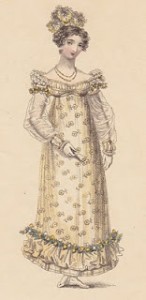
1817 Regency Gown
1817 Regency Gown
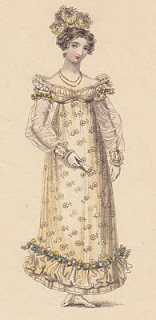
Fashionable Americans wore the same styles as their European counterparts, and made every effort to keep up with the latest trends. In 1817, for ladies this meant higher waists than ever before and sculpted bodices. Hemlines were also higher than ever and skirts were wider and more frilled than during other times in the Regency Era. I especially give a close up look at the ball gowns of that day since my heroine’s mother is a seamstress. You’ll also see plenty of the hats, gloves, and fans that this era is known for. In men’s fashion the style had moved to trousers rather than breeches, and Hessian boots had grown passĂ©. Although, you’ll still see these boots on some of my less fashion conscious characters.
Science
Of course scientific advances are the same in both the United States and England. The US could boast several impressive universities at that time, and plans for building the University of Virginia in Charlottesville were already underway. Let’s not forget that Benjamin Franklin had been an American innovator in science not long ago. My heroine’s sister, Patience Cavendish, has a love for science and a penchant for discussing the latest theories of heat and sound. Like her former president, Thomas Jefferson, she is very influenced by Enlightenment thinking.

Politics

Both England and America were still recovering from the War of 1812. In addition, the abolitionist movement was active in both countries. Britain had abolished all slave trade at this time, although not slavery itself. America had recently abolished international slave trade but not domestic. Of course, my abolitionist characters hope that America will keep the momentum moving toward freedom, but I’m concerned that unlike in England, it will take drastic measures to put an end to slavery in the American South.

Economics 

Both countries were still recovering from the devastating effects of the “Year without a Summer” of 1816, which was reportedly caused by a volcano in Indonesia. Virginia itself was far enough south to escape the worst of the famine, but it did affect the economy throughout the US and earned several mentions in my book. It comes into play as my hero, Robert Montgomery, makes some important business decisions about his plantation.

Arts and Architecture 

Monticello
Monticello
The Romantic Movement was fashionable in art at this time throughout Europe and the US. My artistic character, Felicity Cavendish, is a fan of this movement. In architecture the style was called “Regency” in England and “Federalist” in America, but both were heavily influenced by the Neo-classical style. This can be seen in Jefferson’s Greek Revival architecture at Monticello and my own fictional creation, White Willow Hall.

Music and Dance

While Americans enjoyed the same cultured composers as their British counterparts, they each had their own unique folk music as well. For high society balls, the dances were nearly identical at this time. England beat us to the “scandalous” waltz, however, when the Prince Regent introduced it in 1816. The waltz coming to America is a primary focus of my book, so you’ll get to enjoy many details of the waltz and other ballroom dances, as well as a peek at the world of ballet. In fact, my heroine Constance Cavendish, turned to teaching dance to support her family after her father died, leaving them destitute. Since men were highly sought as dance masters at the time, Constance must move to the frontier in search of better employment.

Religion

A few weeks ago on Regency Reflections Reagan Walker shared an in depth article on this blog about the religion of this time in England. I loved this quote she shared from an Anglican minister about other Anglican ministers of this time. “[With few exceptions] the clergy held and taught a negative and cold Protestantism deadening to the imagination, studiously repressive to the emotions, and based on principles which found little sanction either in reason or in history. The laity willingly accepted it, as it made so little demand upon their conscience, so little claim upon their life.” My heroine’s spiritual journey is moving from this type of thinking to a warm and vibrant evangelical sort of faith, also typical of this time, thanks to my handsome circuit riding preacher, Lorimer.
Naturally, some elements in the book are purely American including Thomas Jefferson, the Monacan Indians, the tobacco plantations, and the frontiersmen in buckskin clothing, but I think you’ll find plenty of European influence to please even the most Regency-loving soul. In fact, my characters enjoy a good Austen novel as well as anyone, although the author is still anonymous at this time. I call this my “Scarlett O’Hara meets Jane Austen novel,” and I included plenty of Austen-like twist and turns for a fun, romantic read you’ll be sure to enjoy.

Dina SleimanExplore the world of 1817 Virginia and follow in the footsteps of Constance Cavendish, the former belle of the ball, who must now teach the dances she once loved and risk her heart in order to restore her family and her faith. As the fiery Constance falls into genteel poverty, the opportunity of a lifetime may await her in the frontier town of Charlottesville. But the position will require her to instruct the sisters of Robert Montgomery—the plantation owner who jilted her when she needed him most. As Robert and Constance make new discoveries about one another, can they face their past and the guilt that threatens to destroy them in time to waltz to a fresh start? Or will the curtain close on Constance for good this time? Fans of Julie Klassen will love this original novel from Dina Sleiman! Download it today for only $3.99! http://zondervan.com/9780310334156 

Monday, November 12, 2012

Waltz - The Forbidden Dance


In the late 1700s and early 1800s the waltz was considered quite a scandalous dance. It gained popularity on the European continent by around 1780, but was still scorned in respectable circles in England and the United States. It wasn’t until the Prince Regent introduced the waltz at a ball in 1816 that it was accepted in England. As for the newly formed US, all we can say for certain is that it was a standard dance by 1830.  


For my new novel, Love in Three-Quarter Time, I assumed that as in all things fashionable, Americans would have followed close on the heels of their British cousins. I showed the waltz being introduced to Charlottesville, Virginia, by a trend-setting plantation matron in 1817. But the waltz of the Regency (or in this case late Federalist) era was quite different than the waltz we know today. It was closely related to the cotillion, and it incorporated a variety of handholds that could, in fact, turn a bit risquĂ© in the wrong company.


Here are just a few lines from a very lengthy poem called “The Waltz,” written by Lord Byron in 1813.


Endearing Waltz! -- to thy more melting tune

Bow Irish jig and ancient rigadoon.
Scotch reels, avaunt! and country-dance, forego
Your future claims to each fantastic toe!
Waltz -- Waltz alone -- both legs and arms demands,
Liberal of feet, and lavish of her hands;
Hands which may freely range in public sight
Where ne'er before --- but --- pray "put out the light.
"Methinks the glare of yonder chandelier
Shines much too far --- or I am much too near;
And true, though strange --- Waltz whispers this remark,
"My slippery steps are safest in the dark!"


The waltz of that time was not the gliding Viennese Waltz or the boxy American Waltz we might be familiar with from dance shows today. It began with a side-by-side promenade called “The March,” but then moved into “The Pirouette” section which involved a variety of holds, some of them quite intimate and hip to hip, with hands linked overhead. The dance then moved into the quicker, hopping "Sauteuse" and"JettĂ©" portions, but always returned to the sensuous pirouettes. Unlike other dances of its time such as cotillions, minuets, reels, gavottes, and country dances which allowed only fleeting contact, the waltz allowed for extended body and eye contact between the partners. These holds allowed ample time for gazing into the partner’s eyes and…shall we say, conversation?

As in Colonial days, dance in the Federalist Era was an essential part of high society life. One’s ability to dance played an essential role in one’s good standing in the community. Little wonder my Mrs. Beaumont was in such a tizzy that her twin daughters were about to be launched into society and she couldn’t secure the best dance instructor in Virginia. And once she did find a suitable teacher, enter my heroine Constance Cavendish, little wonder that Mrs. Beaumont desired to wow her peers by being the first to thpresent the waltz in her area.


Thomas Jefferson, who makes a cameo appearance in my novel as a retired president and resident of Albemarle County, once wrote that dance “is a healthy exercise, elegant and very attractive for young people.” And as Jefferson spent much time in France, I surmise he would have enjoyed a good waltz himself.
I had tons of fun playing with the idea of introducing this “scandalous” dance into the polite society of the planter elite class in Albemarle County, Virginia. I hope you have fun reading about it as well. If you’d like to get a peek at the Regency Era waltz, check out this video. The filming quality is poor, but it’s the only one I could find that shows one of the more questionable holds. 

For more on the waltz, check out my novel, Love in Three-Quarter Time, only $3.99 for ebooks.

Monday, October 29, 2012

Let God Lead Your Dance


Click to purchase
When I first sat down to write Love in Three-Quarter Time, I figured that since the book was about the waltz, the perfect spiritual theme would be “let God lead your dance.” My heroine, Constance Cavendish, had spent her youth as a Scarlet O’Hara type character, selfish and headstrong, yet with an admirable strength and passion. After tragedy struck her family when she was sixteen, she blamed herself and determined to tame her passionate nature and somehow earn God’s forgiveness.

Of course, I hope my reader will understand that none of us can earn our way to forgiveness, but if not, they can take that journey along with Constance. Constance needs to learn that God created her passionate, fiery nature. Her goal should not be to repress it, but rather to submit it to God. To let Him lead her life much like a dance, following with His gentle tugs and sways. I chose as a theme verse for this book, “Lead me in thy truth, and teach me: for thou art the God of my salvation; on thee do I wait all the day,” from Psalm 25:5.

And as I started this book, I assumed I would keep the spiritual theme focused and simple, but books, and life, never really turn out that way. First, to get to this theme, Constance had to learn about one of my all-time favorite spiritual themes, the importance of an intimate relationship with Christ. One cannot stay in tune with God and follow His rhythms for one’s life without that intimate connection. Constance had to learn to see God from a new perspective. She needed to immerse herself in God’s word and in prayer, and she needed to learn to hear His voice.

As she discovered intimacy with Christ and learned to let God lead her dance, she also began to discover freedom in Christ. Yet another theme I love. In fact, my personal life and writing theme verse is, “Learn the unforced rhythms of grace. I won't lay anything heavy or ill-fitting on you. Keep company with me and you'll learn to live freely and lightly.” See how nicely letting God teach you His rhythms flows into freedom in that verse. And since a subplot of the book concerns the abolitionist movement, guess what? Freedom became a theme in the book as well. Both Constance and her hero needed God’s freedom in their lives. Particularly freedom from the mistakes of their past.

And how does one get free from the mistakes of one’s past? More often than not, by facing the truth. By learning God’s perspective on the truth to replace the lies of Satan for starters, but also by dealing with the truth, revealing our secrets, and making amends. Both my hero and my heroine were held in bondage by secrets from their pasts. So, before I knew it, truth became a theme in the book as well. The truth shall set you free and all that.

By this time, my "simple little historical romance" had almost as many themes as my epic historical saga! And I swear, I didn’t even do it on purpose.  But no issue exists in a vacuum. Our spiritual journeys contain many facets. And I think this journey develops in an organic way. The fact is, my "simple little historical romance" ended up with more of a spiritual focus than I ever expected. It became a love story with Jesus as much as anything else, and I couldn’t be more pleased.

Here is a lovely example of a contemporary waltz for your viewing pleasure. Imagine yourself dancing in the arms of Jesus.

Which of these themes interests you the most? Have you learned to let God lead your dance? If so, what advice do you have on the subject? I'd love to hear your thoughts on freedom and truth as well.

Monday, October 22, 2012

Tomorrow's the Big Day!

Love in Three-Quarter Time releases tomorrow! If you pre-order today, it should be waiting for you. The Zondervan page has links to all the retailers currently carrying it: http://zondervan.com/9780310334156. And the price is awesome, only $3.99. See my blog tour schedule in last week's post. In preparation for tomorrow, I've added a book club link here on my website. I've also created a list of discussion questions.


1.       In the prologue of the book we see a very different Constance than the girl found in chapter one. Compare and contrast the two versions of Constance. Which version do you like better and why?
2.       Have you ever repressed part of your true nature? If so why? What was the result?
3.       Have you ever felt like God was looking over your shoulder waiting to punish you? If you could send Constance a message at this point of the book, what would you want to say to her?
4.       How do you feel when you think back on the days of slavery in our country? How do you think you would have responded if you lived in those days?
5.       Do you like to dance? Why or why not? What is your favorite style of dance?  Would you like to learn it?
6.       What do you think of Robbie’s hesitation to ask God for help? What issues hinder your prayer life?
7.       Robbie’s hesitation to ask God for help was probably more typical in his generation than today due to their Deist philosophy. What beliefs of today’s society might cloud our theological beliefs?
8.       What was your first reaction to Lorimer? Did your opinions change as you got to know him better?
9.       Compare and contrast the character of Patience with the character of Constance.
10.   Of the three men in the story, Robbie, Lorimer, and Franklin, who appeals to you the most personally? Why?
11.   Who do you see as the best match for Constance?  Why?
12.   Do you study the Bible as Constance attempted to in the book? What methods work best for you? What struggles do you face?
13.   Discuss the symbols of heat and fire in the book. What change occurred in Constance at the bonfire? How did Robbie feel as he stared into the fire at Monticello? Is “heat” needed in a relationship?
14.   Consider the subject of passion. How do you feel about passion? What were your thoughts before reading this book? Did they change at all while reading?
15.   How do you best hear from God? Did you learn anything about hearing God’s voice through any of the characters in the book?
16.   What strides did the characters in the book take towards racial reconciliation? Do you feel like this is still an issue today? If so, how should you respond to it?
17.   For some of the main characters, their stories are left open ended. What issues are they left with at the end of the book? If you could continue their stories, what would you wish for them?
18.   The ending of the book involves facing a hard truth from the past. Do you think the characters involved made the right decision in sharing this truth? Do you think all secrets should be revealed? Should God’s timing and guidance play a part in the revelation?
19.   The theme of the book is “let God lead your dance.” How do the various characters in the book respond to this theme? How do you feel about this theme?
20.   Discuss what freedom means to you. Where does true freedom come from? What does it look like? At what point does one person’s freedom infringe upon others?

Monday, October 15, 2012

News! News! News!

First important announcement is that Love in Three-Quarter Time is now available for pre-order on amazon, Barnes and Noble, etc... It makes me happy to see it :) I especially enjoy perusing the "Sold by: HarperCollins Publishing" line and the awesome $3.99 price! And just in case you forgot how pretty the cover is...


Also, next week is the official release on October 23rd.

And! I'll be kicking off a very busy blog tour. I'm trying to keep each article fresh and original so that you can learn a little something new about the book, it's background, and me--the author--at each stop. Here's what's coming in October:

October 22nd: First online review!!! http://colonialquills.blogspot.com/
October 22nd: I'll be sharing my thoughts on romance at http://thewritersalleys.blogspot.com/
October 22nd: Interview by Roseanna White at http://www.inkwellinspirations.com/
October 23rd: CJ Chase will be talking about the evolution of dance at http://www.inkwellinspirations.com/
October 24th: Article about my writing and Zondervan's new line by DeAnna Dodson at http://www.inkwellinspirations.com/
October 24th: I'll be sharing about history of the waltz at http://colonialquills.blogspot.com/
October 25th: I'll be posting about the spiritual themes at http://www.inkwellinspirations.com/
October 26th: Review by Debra Marvin at http://www.inkwellinspirations.com/
October 29th: My article on the history in my novel http://susiefinkbeiner.com/

I'll let you know about my November/December schedule as they approach.

Hope to see you on tour!

Blessings, Dina

Monday, September 3, 2012

A Cover and A Release Date!

I'll keep today's post short and sweet. I now have a cover and a release date for Love in Three-Quarter Time! Look for it in print and in ebook on October 23rd through a variety of online and ebook retailers.


Wondering what the back cover says?


The Last Best Dance

Explore the world of 1817 Virginia and follow in the footsteps of Constance Cavendish, the former belle of the ball, who must now teach the dances she once loved and risk her heart in order to restore her family and her faith.

As the fiery Constance falls into genteel poverty, the opportunity of a lifetime may await her in the frontier town of Charlottesville. But the position will require her to instruct the sisters of Robert Montgomery—the plantation owner who jilted her when she needed him most.

As Robert and Constance make new discoveries about one another, can they face their past and the guilt that threatens to destroy them in time to waltz to a fresh start? Or will the curtain close on Constance for good this time?


Bio
Dina Sleiman writes lyrical stories that dance with light. Most of the time you will find this Virginia Beach resident reading, biking, dancing, or hanging out with her husband and three children, preferably at the oceanfront. Since finishing her Professional Writing MA in 1994, she has enjoyed many opportunities to teach literature, writing, and the arts. She was the Overall Winner in the 2009 Touched by Love contest for unpublished authors. Her debut novel, Dance of the Dandelion released with WhiteFire Publishing in 2011. Join her as she discovers the unforced rhythms of grace. www.dinasleiman.com

Monday, August 20, 2012

The History of Love in Three-Quarter Time


I have a confession to make. I’m not really a history person. At least not in the typical sense of dates and facts, rulers and wars. What I love would probably be referred to more as humanities. I enjoy cultures. The art and architecture and literature of a people group. What did they believe? What made them tick? What music did they live their lives to? In my new historical romance novel, Love in Three-Quarter Time, I had the opportunity to fuse some of my favorite cultures into one novel.

Regency Influence
The Regency period generally refers to the reign of the Price Regent in England in the early part of the 1800s. That’s about as much of the history as interests me personally. But oh the culture! Classical music, ballroom dance, card games, drawing rooms, empire fashions, and a feel of unsurpassed elegance. While my book takes place in the frontiers of America where manners and customs are not nearly as strict as in England, since many of my characters have English roots, it still contains a lovely Regency feel.

Perhaps the Regency influence is best seen in the importance of the waltz. At the time, being an expert at dance was a true marker of high society. While the waltz had been popular on the continent of Europe for years, it was considered scandalous by the conservative Brits and their provincial American counterparts. All of that changed in 1816 when the Prince Regent officially introduced the waltz at a ball. I never was able to pin down a date when it came to America, but as it was well established by the 1830s, my guess is that some brave soul must have introduced it shortly after it became popular in Britain.

Southern Plantation Setting
Most of Love in Three Quarter Time takes place on a southern plantation near Charlottesville, Virginia. Of course this allows for a gorgeous Georgian style mansion, balls, tea on the verandahs, and horseback riding through rolling hills. However it also brings up the tricky topic of slavery. While serious historical novels that face slavery head on and show the full ugliness of the institution can occasionally find a place in Christian fiction, in a genre like historical romance, one must tread lightly. For my novel, I chose to have three of my main characters involved in the abolitionist cause. In addition, at the plantation where the novel is set, slaves are treated kindly, like family.

I felt both of these elements were important to provide an enjoyable exploration of this time for my readers. In this way, the reader does not feel the need to excuse the institution for the sake of the characters, nor are they constantly being brought down by the sadness deeply engrained in the Southern lifestyle. However, I do not avoid the ugliness when it’s important to the story. The abolitionist cause does play an important role in the plot, and by the end, I think the readers will have a greater appreciation for those who fought to end the institution of slavery in our country. I also believe that the inclusion of African-American culture in this book brings depth and heart to the situation.

Native American Culture
Being so close to what was still considered the frontier of America in 1817, my novel also explores elements of Native American culture. Perhaps my most exciting find upon researching for this book was the Black Indian tribe. The Black Indians were a mixed race group of people that included many runaway slaves. That might give you a hint as to how I wove this people group into the plot. They adopted the Indian lifestyle and hid themselves away in the mountains of Virginia. The most famous Black Indians were a Monacan tribe near Bear Mountain in Amherst County. I moved my village slightly north to facilitate my story, however the Monacans did reside throughout the Shenandoah Mountains. I use the Indian culture in my story to allow my passionate heroine an opportunity to break free from Regency customs and explore her more earthy side.

My primary spiritual advisor in this book is an enigmatic circuit preacher named Lorimer. Because he’s been called to minister to the slaves and Indians, he has a unique perspective that draws from both cultures as well as the more British Anglican and Methodist teachings. Of course, all of his personal beliefs are based upon his intensive study of the scripture. This brings a very rich and vibrant sort of spirituality to the book that draws Constance closer to Christ, and I hope it will draw my readers closer to him as well. In fact, the reader has the opportunity to explore Christian worship services of all three groups along with Constance.

I had a fun time merging these cultures in my Jane Austen meets Scarlet O’Hara novel! Of course it took a little creativity to blend all of this history together, so please forgive me if I ever let my imagination lead me astray. Overall, I think I managed to capture all three influences, and I think that you’ll have as much fun with them as I did.

Which culture do you know the most about, Regency, Southern Plantation, or American Indian? Which do you like the best? What is your favorite culture?

Monday, August 6, 2012

The Cast of Love in Three-Quarter Time

Authors are often asked to cast their characters with current television and movie actors. It's a good exercise for us, and it also helps when we have to turn in a cover sheet questionnaire to our publishers. We can have pictures right at our fingertips to demonstrate what we might like to see on the front of our books.

Here's my proposed cast of characters for Love in Three-Quarter Time. Let's start with the main character, Constance Cavendish. For her, I chose Bella Thorne. Bella, like Constance, is adorable, funny, passionate, and a dancer. Only problem is, as the star of a Disney sitcom, Bella is only fifteen. But since you can't really tell that she's so young, I figured she would work. Plus, Constance is sixteen in the prologue of my book. So I imagine if you would put Bella's hair in a chignon and don her in a Regency gown she'd be just about perfect.


Next is one of the members of my love triangle, Robbie Montgomery, the young plantation owner. Probably the best actor for his role would be Zac Efron, but we'd need to die his hair just a little bit darker.


Now comes Lorimer, the enigmatic circuit preacher, and probably my personal favorite character in this whole series. The actor I was originally thinking of was too old for the role, but he gave me a good picture in my head. This is Kevin McKidd from Grey's Anatomy, and if you've seen the show, you'll understand that I was often imagining him opposite a young Patrick Dempsey as Robbie.
.


But I have since found this Bachelorette contestant who really could be the perfect Lorimer. 


That brings us to Patience, Constance's younger sister, who has her own story arc in the book. Patience is much more practical and scientific than Contance. The best actress I've seen for her, Challen Cates, is a good bit too old and her eyes should be amber colored, but she'll have to suffice for now. The face shape, hair color, and dimples are what caught my attention. She plays a very practical, organized mom on a Nickelodeon sitcom. (Can you tell what kind of shows we watch at my house?) Her general demeanor fits Patience really well. The second picture could also be a potential Patience. The eyes are perfect, but I'm not sure who this is. Anyone know?


To round off my cast of point of view characters is Theodore Franklin, the science teacher. According to Constance, he's plain and boring, but Patience sees him as attractive and adorable in a bookish, bespectacled sort of way. For him, I'm going to choose Joseph Gordon-Levit. Although, of course, we'd need to add some Benjamin Franklin style glasses.
So those are my picks for the stars of Love in Three-Quarter Time, but feel free to choose your own. That's half the fun of reading novels. You get to form your own pictures in your head. I hope this helped to whet your appetite for the the book, though. Look for it October 23rd through all your favorite online and ebook distributors.

If you were to write a novel, who would you like to see in the cast?

Monday, July 23, 2012

The Setting for Love in Three-Quarter Time

Stories come to authors in all different forms. Really, the impetus for this story first came from my agent who asked me to write a historical romance novel set in America during the 19th century. From there we narrowed down the setting to Virginia or Pennsylvania, the two states I know the most about. Then after several weeks of prayer, the initial idea came to me in the form of the title, Love in Three-Quarter Time. So I knew it would have something to do with the waltz.

Regency Era Waltz
I wanted it to take place when the waltz first came to America. However, I could only find absolute documentation that the waltz was officially accepted in England in 1816, when it was included in a ball given by the Prince Regent, and that it was well established in America by 1830. From there I chose 1817, figuring some daring Americans probably tried shortly after their British counterparts. And by choosing this time, I was able to give my book that popular Regency flavor.

Next I needed a place for my story. It seemed that it should start in Richmond and move to a gorgeous Southern plantation home nearer the frontier. So I created the fictional White Willow Hall just off the famous Three Notch'd Road which ran through Charlottesville, Virginia. I decided my plantation would be set in rolling hills with a weeping willow, lots of flowers, and a small pond out front. For the architecture, I thought my Beaumont family might have chosen something similar to the nearby Monticello. Oh! And I would include a few scenes at Monticello for an added historical touch.

Monticello
So I went about writing my book, mostly from my imagination and my memories of Charlottesville. I did some online research. But it wasn't until I had already completed the first draft that I had an opportunity to visit while I was in Charlottesville for the Virginia Festival of the Book. It was quite a feat to figure out where Three Notch'd Road ran today, but with the help of the ladies at the Monticello gift shop, I finally figured it out. Then of course it was farther than expected, and I was running out of gas, and my GPS kept taking me to old country gas stations that weren't open.... Suffice to say, it was the next afternoon before I skipped out on the festival and managed to explore Three Notch'd Road west of the town.

Dina at Birdwood Pavilion (Now a Conference Center) on Three Notch'd Road
And it was so worth it!!!! I found a plantation about 3 miles west of town, right where it belonged, that fit my description almost precisely. The willow and pond were more to the right side than in front. The house did not have a rotunda, but the size, red brick, white pillars, and verandas all matched! You can't tell in the picture, but there are about two sets of rolling hills between me and the house. The plantation would have existed at the time of my story, although the house was built a few years later. I was so excited that I went back after the festival with my travel companion, author Christy Barritt, to snap some pictures.

Garden Pavilion at Monticello
But don't forget those few scenes at Monticello as well. I had actually found great online tours, photos, and videos. So there weren't too many surprises for me. I was, however, oddly shocked that it sat on top of the only mountain in the area. Duh! Thus the name. But I didn't realize there were any mountains that far east. My favorite place at Monticello was a spot where I had already set a pivotal scene. This lovely little garden pavilion where Constance and Robbie shared a passionate kiss for the first time in five years.

I had so much fun with the setting of this story. I hope you'll enjoy it too!

What's your favorite historical time and place? Do you enjoy Southern plantations and old mansions? If you could set a book anywhere, where would you choose?